Sci-fi explores possible trajectories of humankind in a technologically advanced future. Often, this setting leads authors to question the outcome of contact with alien intelligences: Will these beings come in peace or be hostile? What will they look like? Do they have a culture, and if so, what is it like? In Solaris1, Stanisław Lem takes a unique approach to this question, and asks: What if an extraterrestrial intelligence was so vast and incomprehensible that even generations of scientific inquiry could not establish the simplest communication?

The story follows the perspective of psychologist Kris Kelvin shortly after his arrival on Solaris, a lonely planet orbiting two stars. Discovered over 100 years before the events of the book take place, Solaris is considered an anomaly due to its unstable and mathematically improbable orbit:
“A modest item among the hundreds of planets discovered annually— to which official statistics devoted only a few lines defining the characteristics of their orbits— Solaris eventually began to attract special attention and attain a high rank.” (16)
When scientific expeditions arrived at Solaris, they discovered the planet’s strange orbit was due to an even stranger ocean. It was not a body of water as one would expect; instead, it is an organic structure, a:
“colloidal envelope several miles thick in places. …the ocean possibly exceeded terrestrial organic structures in complexity, since it was capable of exerting an active influence on the planet’s orbital path.” (18)
What followed was several decades of scientific inquiry into the exact nature of this organic ocean. It was established that Solaris’s unusual orbit must be controlled by the ocean, but the exact mechanisms by which it did so remained elusive. Equally perplexing was the question of whether or not the ocean is “alive”. Multiple theories arose on the subject. Some scientists shared the view that the ocean was:
“…a lifeless chemical conglomerate, a gelatinous mass which … stabilized its eccentric orbit by virtue of a self-generated mechanical process…” (165)
Others saw the matter differently, and put forth that the ocean was a complex, sentient life form which possessed a will of its own. The ultimate proof of such a theory would be in establishing communication with the “reasoning monster” (165).
By the time Dr. Kelvin arrives on the Solaris research station, scientific inquiry related to the planet has stalled. Decades of research and attempts to prove the ocean’s sentience or establish contact have failed, and humankind is no closer to an answer than when it first arrived. However, it soon becomes obvious to the skeleton crew of scientists aboard the station that the planet is sentient, as it begins to communicate in frightening and gruesome ways.
However astonishing the concept of a faraway planet with a sentient ocean may seem, Solaris actually mirrors Earth in many ways. Both Earth and Solaris have evolved complex mechanisms that sustain life, have undergone years of relatively fruitless scientific inquiry, and both planets challenge the human-centric view of intelligence.
In Solaris, the evolution of any biological life, let alone a massive, alive ocean of exceeding complexity, on a planet that orbits two stars presents a paradox. Binary star systems are a poor place to evolve life because the fluctuations in gravity would obliterate life before it got a chance to start. However, Solaris’s ocean obviously evolved at some point. It simply adapted the environment to suit its needs, rather than the other way around.
The evolution of life on Earth likely began in equally inhospitable territory. The first inhabitants were probably organisms that harvested chemical energy from hot, toxic geothermal vents. As evolution progressed, this early life changed its environment, evolving oxygenic photosynthesis which produced an atmosphere capable of withstanding the maturing Sun’s increasingly intense UV radiation. The creation of a thicker atmosphere was a lucky accident, but it allowed for the proliferation of unique lifeforms, which formed the foundation of biological diversity today. To put it plainly, both Solaris and Earth evolved life-support systems that continue to adapt to long-term changes in the cosmic environment.
In Solaris, the eponymous planet’s ocean uproots humankind’s tenuous understanding of life. The humans in the story simply lack the intellectual and scientific tools necessary to understand an organism whose history and evolution is completely separate from our own. If the roles were reversed, how would intelligent aliens interpret what they observe of Earth?
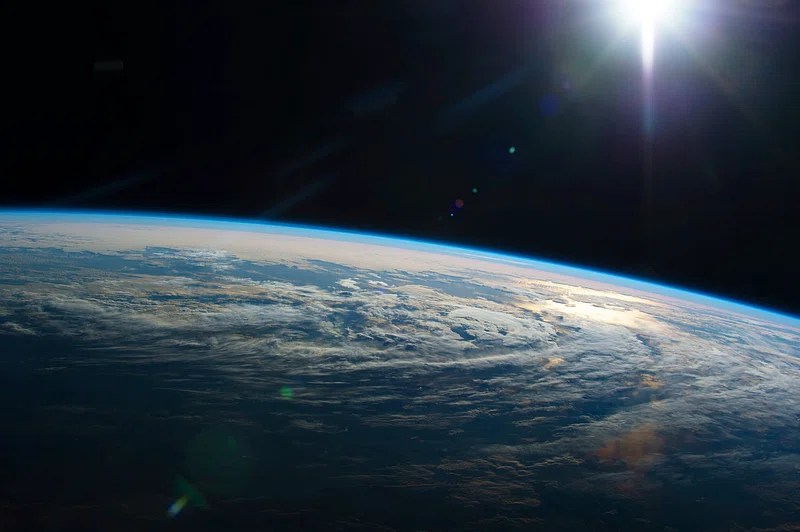
If we apply the same logic to Earth as we do Solaris, we find that Earth, from an alien perspective, seems sentient. Like Solaris, Earth is also covered in an apparent ocean of biological material, with over 2.16 million species weighing in at an estimated 550 gigatons. The entire system is interlinked and interdependent— organisms receive inputs and create outputs that are used by others in a cycle that sustains itself and will continue in perpetuity. Vast swaths of forests and grasslands communicate and coordinate through an underground networks of fungal pathways. The tightly coupled abiotic and biotic elements of this planet can be viewed as the workings of a superorganism, an entity who displays a level of sentience and intelligence on a cosmic scale.

Both Earth and Solaris have been the subject of prolific study in their respective realities. In Solaris, volumes of scientific textbooks and journals have resulted in dead-ends, and the question of Solaris’s sentience remains unanswered. As Dr. Kelvin states:
“…all the information accumulated in the libraries amounted to a useless jumble of words, a sludge of statements and suppositions, and that we had not progressed an inch in the 78 years since researches had begun.” (22-23)
Centuries of scientific study into Earth processes have yielded significant advances in our understanding, yet many fields would share Dr. Kelvin’s sentiment. Ecology, for example, has accrued an unmanageable amount ideas and theories, many of which lack general consensus. The result has been relative stagnation with no revolutionary advancements in understanding. On Earth and in Solaris, progress is often obstructed by a tangle of ideas, either recycled from previous generations, or quickly leading to dead-ends. Is it possible that stalled discourse, like in Solaris, is standing in the way of recognizing Earth as sentient?
The futile scientific debates that Dr. Kelvin describes stands in stark contrast to his firsthand experiences. While the scientific community bickers and argues over the validity of Solaris’s sentience, Dr. Kelvin is witnessing that sentience first-hand. Similarly, the concept of Earth as a superorganism is given little validity in the scientific community. Yet, everyday people witness the sentience of Earth— they feel the Earth breathe, they behold the biological symphony of species in competition and cooperation, and, if they’re lucky, they glimpse the planetary synapses that coordinate life.
Humans only recognize intelligence in relation to the purposes it serves. Non-human intelligence is therefore difficult to understand because it exists apart from human motivations and purpose. At the end of Solaris, Dr.Kelvin acknowledges that Solaris can only be understood on its own terms, and, he states, as an “imperfect god”:
“That is the only god I could imagine believing in, a god whose passion is not a redemption, who saves nothing, fulfills no purpose—a god who simply is.” (199)
If there are aliens out in the universe watching, do they see Earth as an “imperfect god”—an entity utterly incomprehensible, yet falling just short of divinity? Are anthropogenic conditions such as climate change, environmental degradation, and war all a short illness and a blip in a god’s 4.5 billion year existence? Are they proof that humans are what makes a god fallible?
If Earth is a home, then we are simply guests who are quickly overstaying our welcome; but, if Earth is an entity in and of itself then that means we are a part of Earth. It means that we and all the other organisms that share this planet are sinew and muscle; heart and brain; bones and blood. How do we justify being at odds with parts of ourselves? Replacing forests with cornfields and using those cornfields to sustain feedlots for thousands of cattle—are we just killing a part of ourselves for profit? Does it make sense to trade our lungs for a bigger stomach? I don’t have the answers to these questions, but I am glad that Solaris made me ask.
The beauty of science fiction is its ability to transport us to a reality that is spatially and temporally distant from our own. It allows us to look back on our “pale-blue dot”, which contains all that we love and know, and realize that there are so many things we still do not understand. Upon returning home, we find we have gained a new perspective— an appreciation of our own “imperfect god”.
- All texts used throughout this essay come from this version:
Lem, S. (1970). Solaris (J. Kilmartin, & S. Cox, Trans.). Harcourt Inc. (Original work published 1961) ↩︎

 Kian Speck
Leave a comment